Blue Cross Blue Shield Blue Care Network of Michigan logo

Long-Term Life Planning Blueprint

senior couple working on their finances at home

To many, the concept of the future seems scary. Most of us live in the present and might not even know what we’re having for breakfast tomorrow. While it’s easy to only look at the not-so-distant future, it’s incredibly important to plan for your long-term needs. It’s never too early to be prepared.

Here are three key ways to make sure your family isn’t left not knowing your wishes in the event of a tragedy or unexpected setback.

  1. Create an estate plan. Estate planning is creating a plan for how your estate will be managed and who will manage it throughout your life and after death. When planning where your belongings will go, it’s also important to consider the other implications that it will pose to the beneficiaries, such as tax and legal effects. Federal and state taxes on estates can be some of the highest. It may seem unnecessary to a college student, but experts encourage young adults in their 20s to start estate planning. It’s always helpful in the event of a tragedy and only requires a few important legal documents.
  2. Designate a power of attorney. Everyone should also have a designated power of attorney. POAs are commonly selected when someone gets to retirement age, however you may select a POA anytime after your 18th birthday. Special circumstances may prompt the need for a POA earlier in life. This person has the power to act on your behalf if you are ever deemed incapable. It should be someone you trust, who knows you well and who would be comfortable making very difficult decisions. Always ask your desired power of attorney if they are okay with the responsibility before you officially designate them as POA.
  3. Consider long-term care insurance. Unlike traditional health insurance, long-term care insurance is designed to help you in the event of a long-term service need. These policies reimburse the policyholder for daily needs such as food, bathing, etc. The cost associated with the policy varies based on a variety of factors, but it is recommended that you apply for long-term care insurance in your 50s. At this age, your health is generally pretty good and you’re able to add coverage down the road if you need it. Learn more about supplemental insurance options to consider here.

For all of these decisions, it is recommended that you consult with a trusted professional advisor to make sure you are choosing the best option for you. They can also offer legal advice in the event of uncertainty.

Long-term planning may seem like a major undertaking, but you can set smaller tasks and goals to accomplish all the planning you need. Breaking it up will help to make it more manageable.

Conversations such as these can be hard, but they are necessary and can save you and your loved ones from confusion down the road.

This article was originally published on www.ahealthiermichigan.org, a website sponsored by Blue Cross Blue Shield of Michigan.  Blue Cross and MADA are your trusted partners in building a healthier business and workforce.

Photo credit: PeopleImages

Image of Michigan Secretary of State seal

Training Reminder for Standalone Class B Dealers

Please note: this does NOT apply to Class A/B…or supplementals to a Class A license

The Michigan Department of State recently mailed dealer license renewals. This is a good time to remind standalone Class B dealers that new regulations require renewing Class B dealers to have a designated employee at each retail sales location that has completed the standard or continuing education dealer training program. A single individual cannot be the designated employee for more than three (3) locations.

When renewing a dealer license, standalone Class B dealers (those not connected to an A license) must sign and certify that this requirement will be done (or has been done). Dealers will have a short grace period after renewal to meet the designated individual training requirement; however, it is recommended that training be completed in advance. The training will be verified by the state in 2020 and violations will be written for non-compliance.

For more information, refer to this March 2019 bulletin from the state, or this FAQ with a link to the training schedule. If you have further questions please contact Jean Quinn at (800) 292-1923 or email jquinn@michiganada.org.

Dealership of Tomorrow: 2019 Update

In 2016 NADA commissioned research on how the American new-car franchised dealership system is evolving, looking at trends ranging from the rate of consolidation of ownership to the potential impact of electric cars, with a target forecast date of 2025. The final report was released in 2017, and was well received.

As the world continues to evolve, NADA asked for an update of the report, and a corresponding extension of the forecast period, to the late 2020s. The final report will be released in late 2019, and presented at NADA 2020 in Las Vegas. MADA is offering our members the opportunity to see the results prior to the NADA Show, in a detailed presentation by the lead researcher, Glenn Mercer.

All dealerships are experiencing change of various levels. As an association, we are helping with a greater number of licensing changes. We are communicating with manufacturers on behalf of dealers, and we know dealers are talking about methods to manage the changing customer shopping patterns and expectations.

This presentation from Glenn Mercer is important to dealers who want valuable insight into the dealership of tomorrow. What do you need to be doing now to be prepared down the road?


Please add this year’s Annual Meeting to your calendar:

December 4, 2019
Kellogg Center, East Lansing

REAL ID may affect you, especially if you travel by air

On Oct. 1, 2020, the federally mandated REAL ID law goes into effect, and if you travel by air, this law will impact you. REAL ID is the post-9/11 federal requirement that sets higher security standards for identification. Once in effect, a REAL ID will be required to board any U.S. flight or to enter some federal facilities. A REAL ID can be a U.S. Passport or an Enhanced Driver’s License – or you can turn your standard driver’s license into a REAL ID at the Secretary of State’s office. Learn more about the law and what documents you need to bring to get a REAL ID at Michigan.gov/REALID.

New left-turn signals on Michigan’s roads

You may have begun to notice a new style of left-turn signal on Michigan’s roads. Placed OVER the left-turn lane at a signalized intersection, this new signal display includes a flashing yellow arrow.  In coming years, this type of signal will replace all flashing red left-turn signals.

How will it work?
In most locations, the flashing yellow arrow will be part of a four-arrow signal. In areas where this is not possible, the bottom of a three-arrow signal will display either the flashing yellow arrow or a steady green arrow.

Signal phases:

red light  Red: STOP.
yellow flashing light Flashing yellow arrow: Left turns permitted.  Yield to oncoming traffic and pedestrians. [Oncoming traffic has a green light.]
green light Green arrow: Safe to turn left. [Oncoming traffic must stop.]
yellow  light Steady yellow arrow: The left-turn signal is about to change to red; prepare to stop, or prepare to complete your left turn if you are within the intersection.

Why the change?
This change is the result of a national study conducted for the Federal Highway Administration, which demonstrated that the new signals:

  • help to prevent crashes
  • move more traffic through an intersection
  • and provide additional traffic management flexibility.

Why is it a better left-turn signal?

  • It’s safer. A national study demonstrated that drivers made fewer mistakes with the new signals than with traditional left-turn arrow signals.
  • It’s more efficient The new signals provide traffic engineers with more options to handle variable traffic volumes.
  • It’s more consistent. You’ll see the same signals in every state because the new signals are being introduced throughout the U.S.


From the Michigan Department of Transportation

Blue Cross Blue Shield Blue Care Network of Michigan logo

How to Prevent Common Desk-Related Injuries

Did you know spending hours at a desk can affect your muscle and bone structure? It can cause you to develop serious conditions that are both painful and debilitating. If you have an office job or lead a sedentary lifestyle, there are ways to reduce your risk of a desk-related injury.

Protect your joints and bones with these office-friendly techniques:

Hands and Wrist

Carpal tunnel is one of the most common injuries among office workers. It’s caused by severe pressure on the median nerve that runs through the wrist. This can lead to tingling or numbness in the fingers as well as muscle atrophy. Avoid these symptoms by taking the following precautions:

  • Keep the arm and wrist closely leveled to each other, with the wrist slightly lower (if possible).
  • Keep frequently used objects close by to prevent strain from strenuous reaching.
  • When possible, avoid bending the wrist completely up or down. This will help relieve pressure from the median nerve.

Upper and Lower Back

Either too much or too little activity can lead to serious back problems. That means overexertion or a lack of mobility, which are linked to stiffness and bad posture. Adding these small changes to your daily routine will keep your back strong and fluid.

  • Make sure the height of your chair allows your feet to rest flat on the floor with your thighs parallel to the ground.
  • Avoid slouching. This can roll your shoulders forward, crushing the nerves in your neck.
  • Just as its important for wrist health, keeping everything within arm’s reach prevents unnecessary bending and twisting.

Eyes 

Eyestrain (asthenopia), is a condition caused by the exhaustive and prolonged use of the eyes. It can be caused by excessive screen time, long drives, stress, fatigue and even dry air. Luckily, eyestrain can be prevented by taking these active measures:

  • When at a desk, keep the computer monitor at arm’s length, with the screen angled slightly below your eye line.
  • Through your display settings, lower the brightness and change the “temperature” of your monitor to a more reddish color.
  • Keep your eyes busy by practicing the 20-20-20 rule. For every 20 minutes of screen time, look at something 20 feet away for 20 seconds.

It’s extremely important to take breaks during the work day. Getting up and walking for a few minutes every hour resets your body to its natural position. You’ll return to your desk feeling loose and refreshed.

If you found this post helpful, check out these blogs:

Buckle Up for the Ones Who Will Miss You

To stress the importance of buckling up, the Michigan Office of Highway Safety Planning (OHSP) recently launched a new safety campaign that includes television and radio ads, billboards, social media posts, and banners displayed at more than 600 police and public safety offices across Michigan. The effort is part of the annual Click It or Ticket seat belt enforcement crackdown that runs May 20 through June 2.

“Three out of four people ejected from a vehicle in a crash will die,” said Michael L. Prince, OHSP director. “Wearing a seat belt is the simplest thing you can do to reduce injuries and save lives. Buckle up for the ones who will miss you – every trip, every time.”

As the Memorial Day holiday approaches, officers from police departments, sheriff’s offices and the Michigan State Police will be conducting seat belt enforcement across the state during the two-week period.

Two new Click It or Ticket ads that are part of the safety campaign by the OHSP remind motorists why it’s important to buckle up. They can be found at:

Last Memorial Day, 19 people died in traffic crashes over the holiday period, almost double the number in 2017. Seat belt use is the single most effective way to stay alive in a crash. Buckling up can reduce the risk of serious injury or death in a crash by 45 percent.

In Michigan, the seat belt usage rate stands at 93.4 percent. The national seat belt use rate in 2018 was 89.6 percent.

Michigan law requires drivers, front seat passengers and passengers 15 and younger in any seating position to be buckled up.  The fine and associated costs for not wearing a seat belt is $65.  Children must be in a car seat or booster seat until they are 8 years old or 4’9” tall, and children under 4 years old must be in the back seat.

The OHSP coordinates the Click It or Ticket effort which is supported by federal traffic safety funds.


https://www.michigan.gov/msp/0,4643,7-123-72297_64773_64776-497454–,00.html 

Northwood University International Auto Show

In its 56th year, The Northwood University International Auto Show (NUIAS) continues to be the largest outdoor new car show in North America. Year after year Northwood University students work tirelessly to display over 500 vehicles from 65 manufacturers. Being 100% student run, the show is funded by the generosity of alumni, supporters, friends, and corporations. This year NUIAS is looking back on its legacy as a premier experiential learning and guest destination. Student captains are focusing on showcasing the history of their brand’s most iconic vehicles.


Founded in 1964, NUIAS is completely free to the community – guests are not required pay admission or parking fees.

2019 Show Hours:

  • Friday Sept. 27: 1pm-6pm
  • Saturday Sept. 28: 9am-6pm
  • Sunday Sept. 29: 10am-5pm


https://nuias.northwood.edu/  


Auto industry drives state parks development

This is part of a series of stories to mark the centennial of Michigan state parks. On May 12, 1919, the Michigan Legislature established the Michigan State Park Commission, paving the way for our state parks system. The Michigan Department of Natural Resources is celebrating this milestone throughout the year with special events, podcasts, historical stories, videos, geocaching and more. Find more details at Michigan.gov/StateParks100.

By CASEY WARNER
Michigan Department of Natural Resources

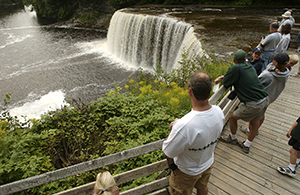
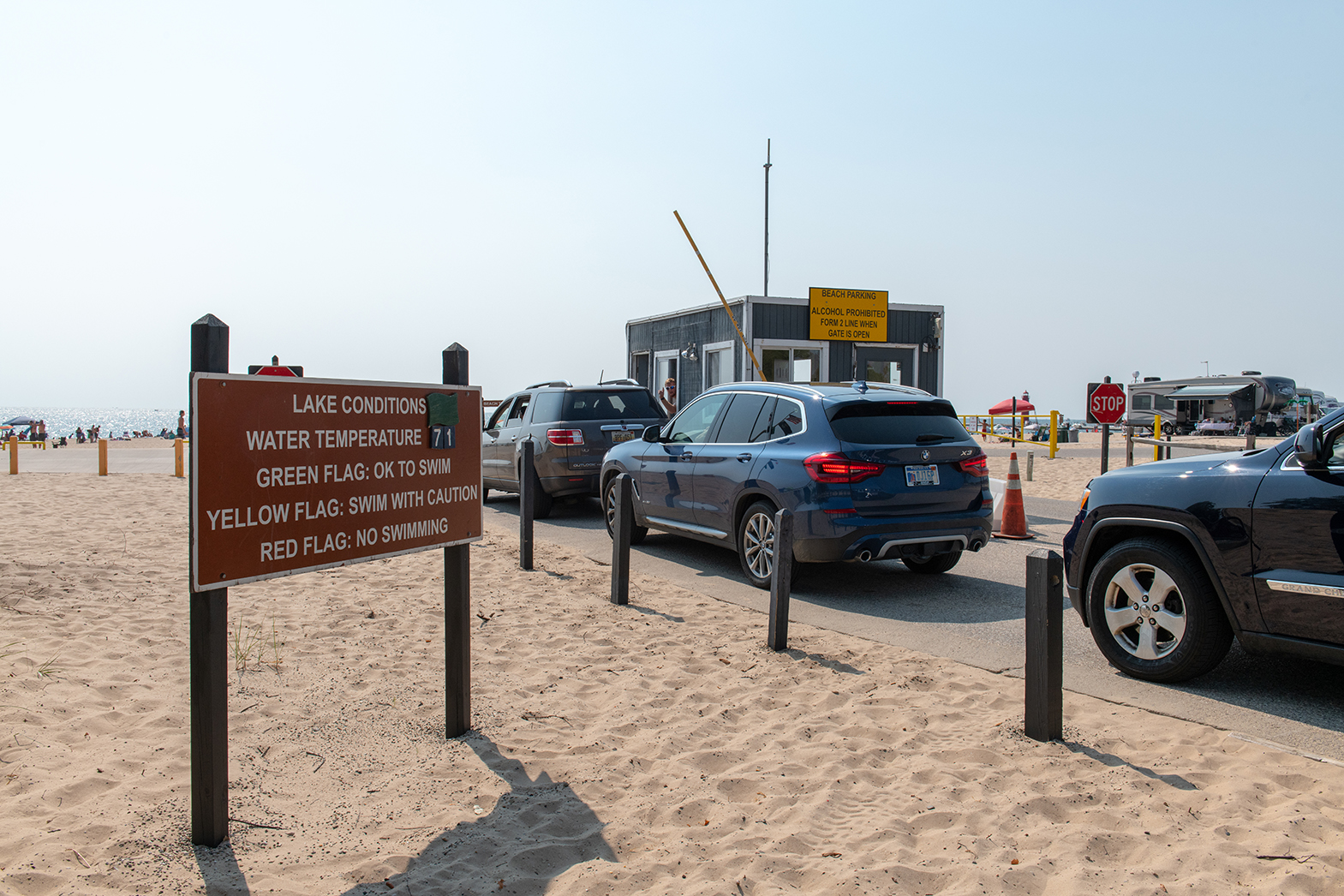
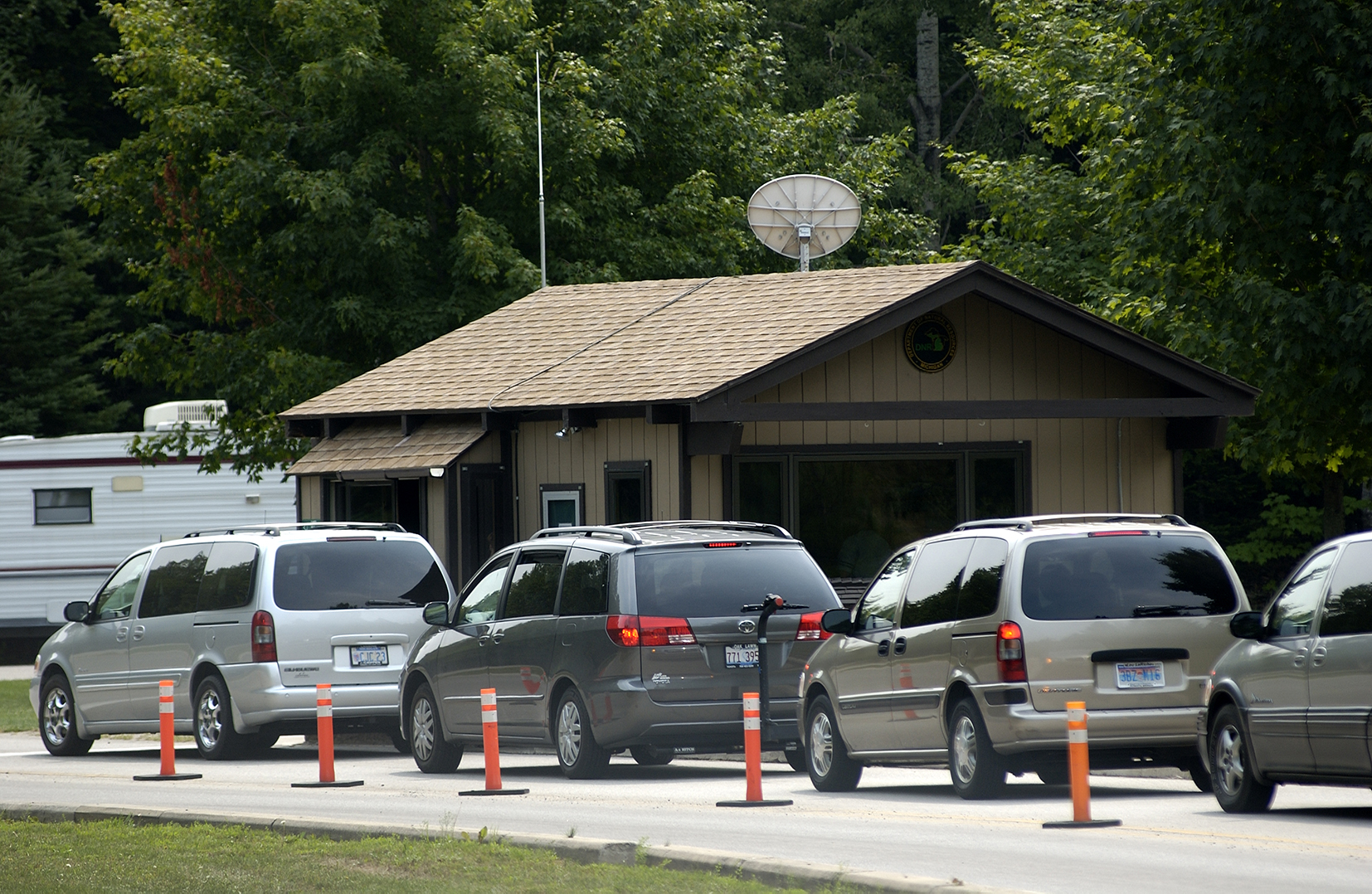
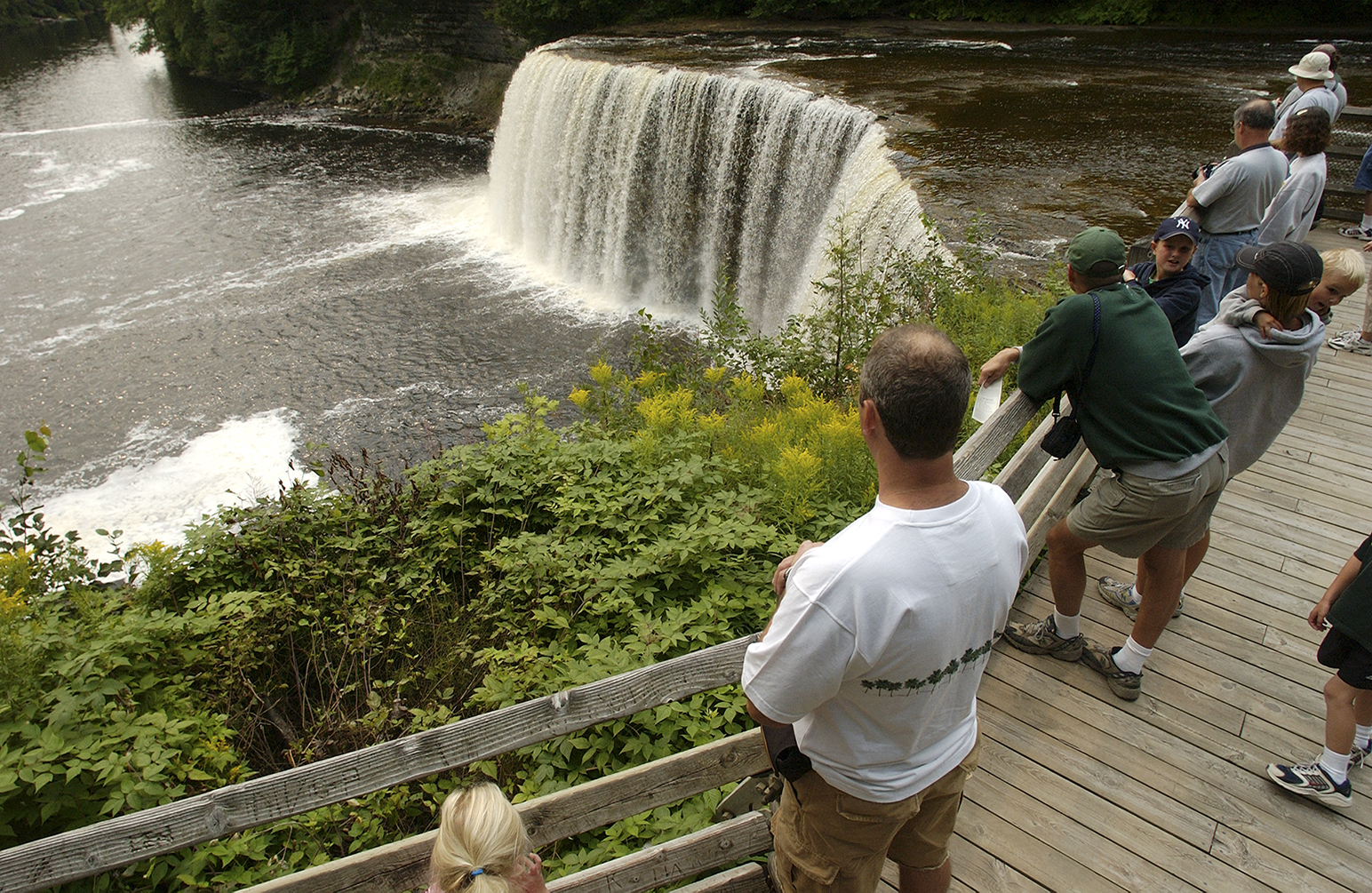
Visitors enjoy the Upper Falls at Tahquamenon Falls State Park in the eastern Upper Peninsula.Visit a popular destination like Grand Haven State Park or Tahquamenon Falls State Park on a sunny summer day, with their bustling parking lots and vehicles lined up at the entry gates, and the link between cars and state parks is evident.

That connection began decades ago, as the burgeoning automobile industry drove development of Michigan’s state park system.

That system dates back to 1919, with the establishment of the Michigan State Park Commission and Interlochen State Park.

During this same era, cars were becoming an increasingly popular mode of transportation.

“The turn of the century marked the start of the motor age and the beginning of a revolution in transportation. Ready access to features of the State would no longer be limited to points on railroads or water routes,” the Michigan Department of Conservation’s “State Parks of Michigan: A Report of the Past, a Look to the Future,” said in 1957.

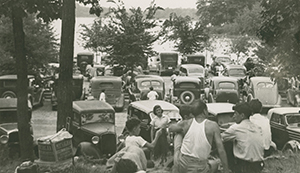
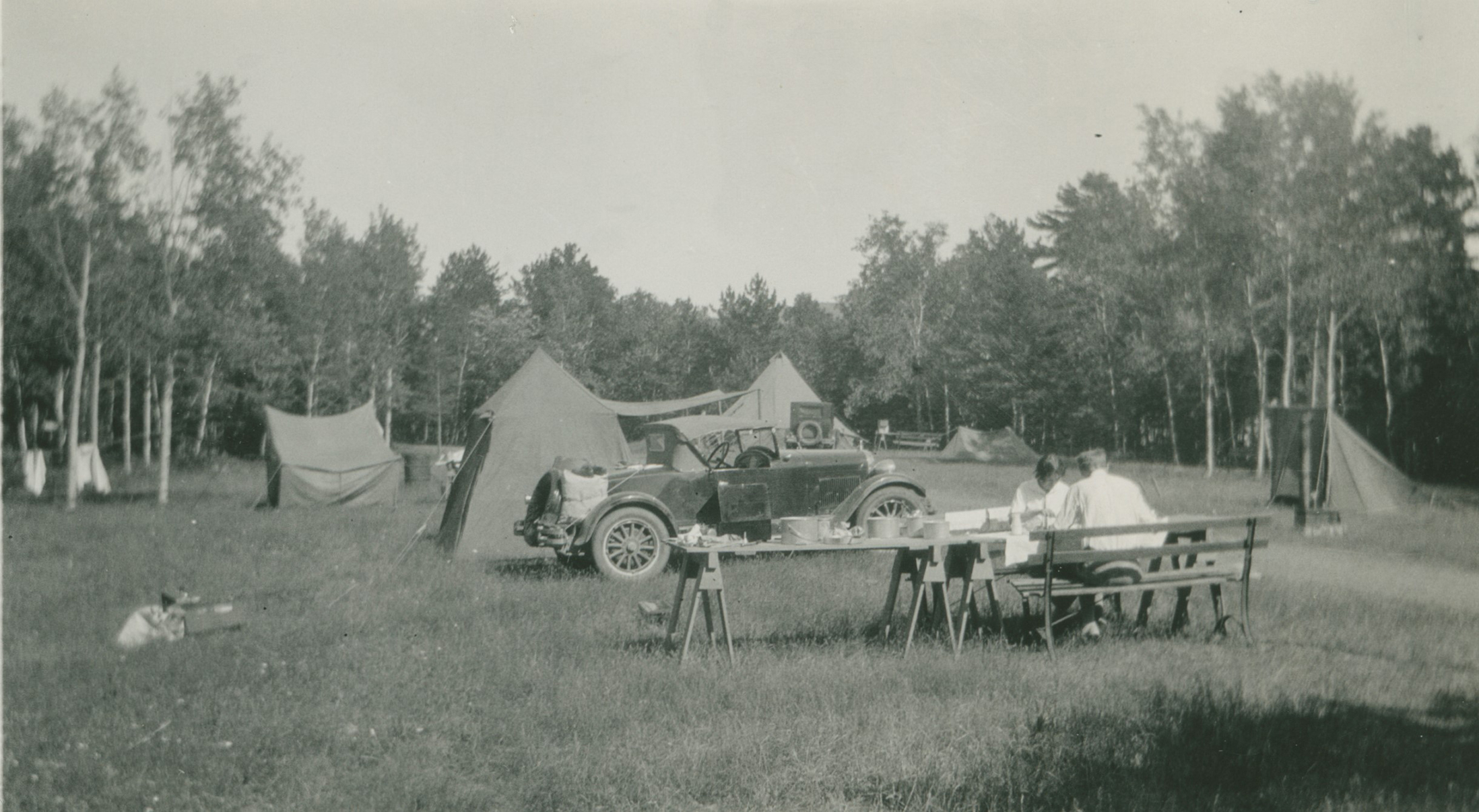
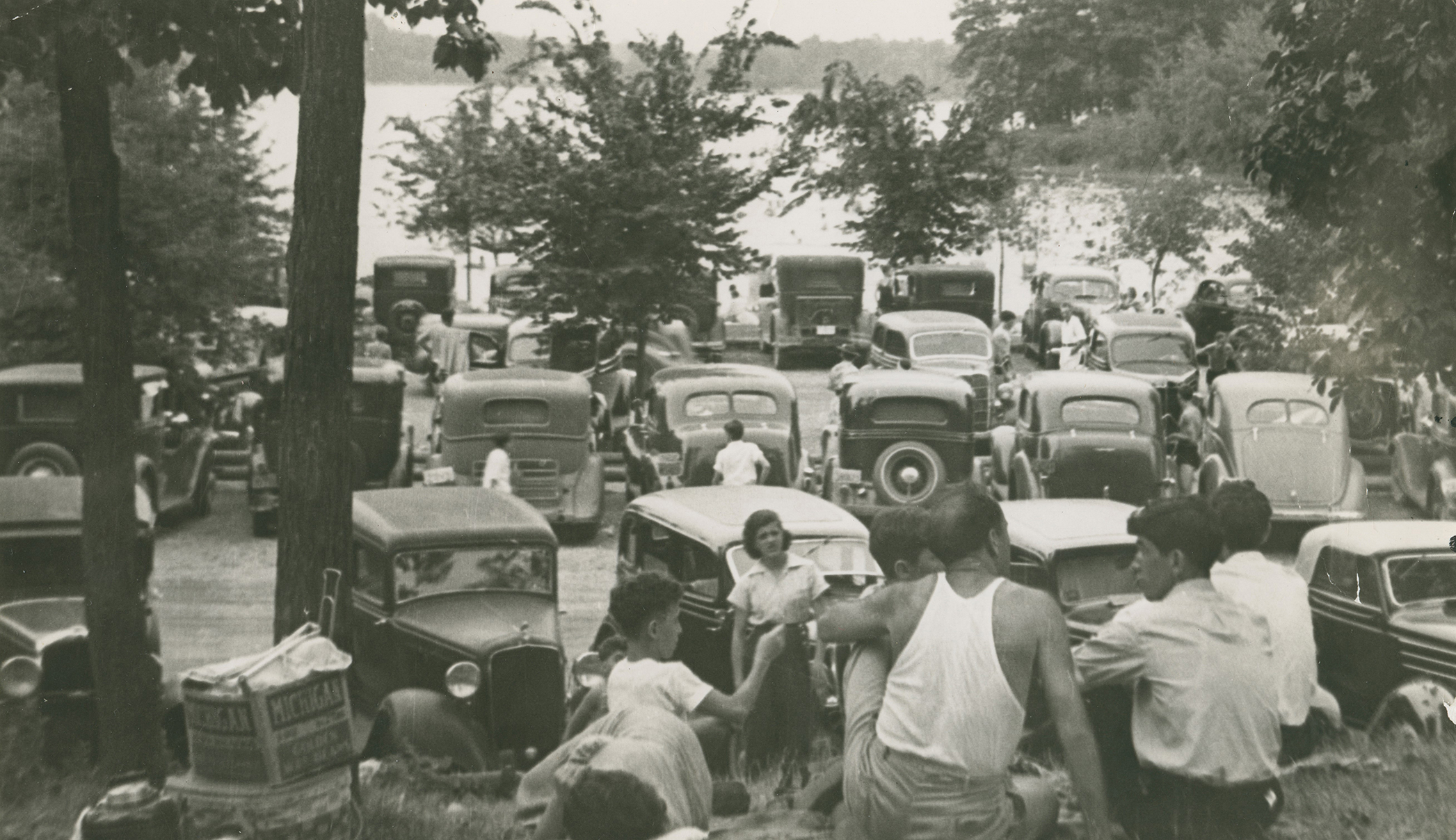
Automobiles and state parks became popular together as is shown here at Island Lake State Park.The auto industry’s growth was an important trend for park development nationwide as well as in Michigan.

By the time the National Park Service was formed in 1916, “motor cars, many mass produced by Michigan technology, were speeding tourists along an expanding network of roads,” Claire V. Korn wrote in the book “Michigan State Parks: Yesterday Through Tomorrow.”

In 1921, when the first National Conference on State Parks convened, Michigan was one of only 17 states that had its own state parks.

“Michigan’s state park system was built on the foundations painstakingly laid at this conference. Before dispersing, the conservationists issued a call for all governments – local, county, state, and national – to acquire recreational lands and waters within easy access of all citizens,” Korn wrote.

The mindset of making outdoor recreation opportunities accessible to travelers was evident on state road maps.

In 1912, Michigan’s highway department issued a free road map of the state. In 1919, the state Legislature authorized the highway department to publish and sell a tourist map. By 1922, that map included state parks, and by 1923 the map also contained information on recreation sites, campsites and ferry schedules.

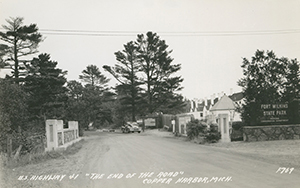
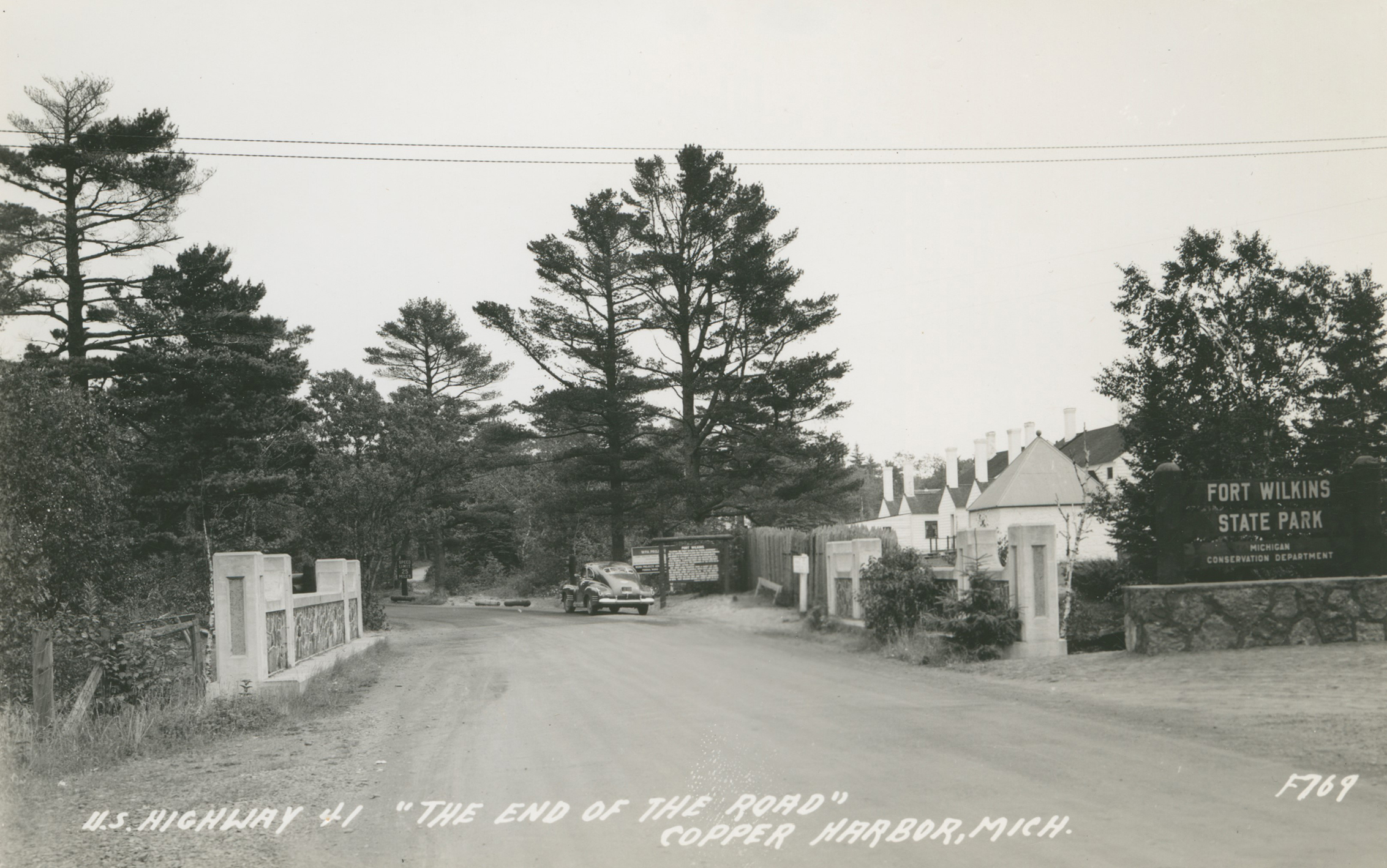
A historic photo shows Fort Wilkins State Historic Park along U.S. 41 in Keweenaw County.In 1919, Michigan also established the nation’s first roadside park, along US-2 in the Upper Peninsula’s Iron County, a development spurred by Iron County Road Commission engineer Herbert Larson’s difficulty in finding a picnic spot while on a vacation to northern Wisconsin.

Access to outdoor recreation became a selling point for both Michigan tourism – with the State Park Commission adopting the slogan “Michigan – America’s Playground” – and cars.

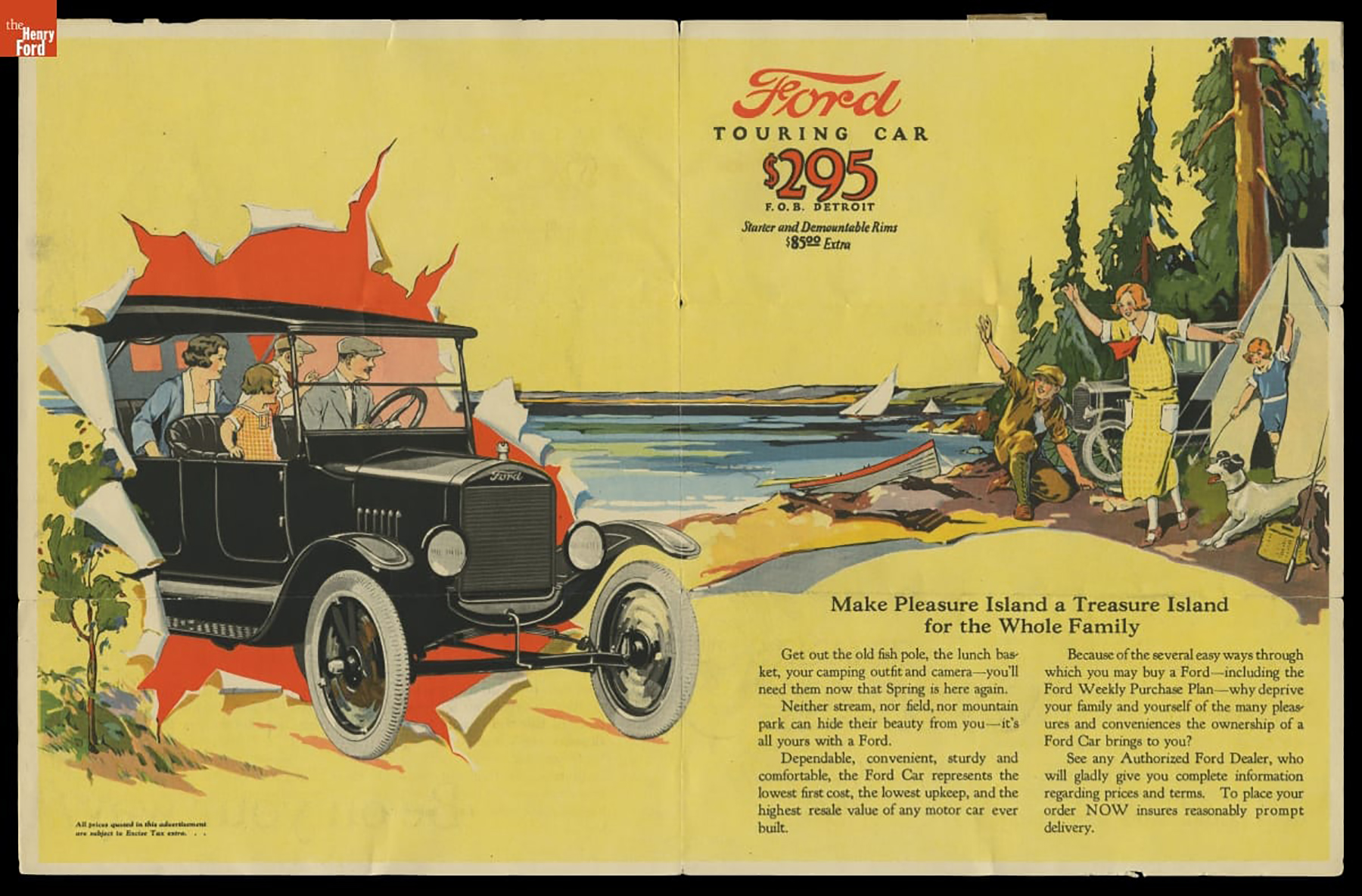
An advertisement for the 1924 Ford Model T, showing a family camping on the lakeshore, said “Get out the old fish pole, the lunch basket, your camping outfit and camera – you’ll need them now that Spring is here again. Neither stream, nor field, nor mountain park can hide their beauty from you – it’s all yours with a Ford.”

With the state’s roads carrying an increasing number of tourists in search of the great outdoors, Michigan also built the nation’s first permanent travel information center at New Buffalo, in the southwest corner of the state near the Indiana border, in 1935.

The expansion of the auto industry in the early 1900s also meant ample job opportunities in Michigan.

“‘Michigan Leads All States in Gain of People in Towns!’ a 1921 newspaper headline trumpeted, and Detroit was bursting its seams.

“The sons of poor struggling farmers, lumberjacks, and miners were flocking to the city to take lucrative and dependable factory jobs. Steady work brought prosperity, and with prosperity came leisure … for the common working family,” Korn wrote.

Beachgoers enjoy Dodge #4 State Park in Oakland County.“At last all the pieces – the idea, the means, the need, the transportation, and the organization – united to fuel the vigorous growth of Michigan’s state park system.”

The Michigan Department of Conservation, in its 1923/1924 biennial report, noted the need to expand parks to keep up with the increase in cars, roads and leisure time:

“The ever increasing number of automobiles, the extension of good roads, together with an increase of efficiency in production which makes available more time for the people to use both the automobile and road – all go to make up the problems of taking care of the increased number of people who are travelling.

The work that is being done and effort spent to cope with other problems caused by the same three factors, is proof enough to show them a great big reality. Questions that arise on this are: Where are they all going? Where should they go? What shall they do when they get there? An adequate system of State Parks will do much towards the solution or answers to these points.”

The report’s recommendations included acquiring more lands in southern Michigan for state parks, enlarging and improving existing park sites, and helping local governments establish parks.

In 1922, the first year park attendance was recorded, state parks welcomed more than 200,000 visitors. By 1930 – eight years later, by which time 30-plus state parks had been established – attendance had skyrocketed to more than 8 million visitors a year, a 40-fold increase.

And by 1955, when another 20 parks had been added to the system, annual state park attendance had grown to almost 18 million.

See a list of dates Michigan state parks were established.

Today, Michigan’s 103 state parks see 28 million visitors a year.

Learn more about Michigan’s state parks at Michigan.gov/StateParks.

Check out previous Showcasing the DNR stories in our archive at Michigan.gov/DNRStories. To subscribe to upcoming Showcasing articles, sign up for free email delivery at Michigan.gov/DNR.


/Note to editors: Contact: John Pepin, Showcasing the DNR series editor, 906-226-1352. Accompanying photos and a text-only version of this story are available below for download. Caption information follows. Credit Michigan Department of Natural Resources, unless otherwise noted.

Text-only version of this story.

Ad: A brochure for the 1924 Ford Model T touts the car as a means to outdoor family fun. (From the collections of The Henry Ford.)

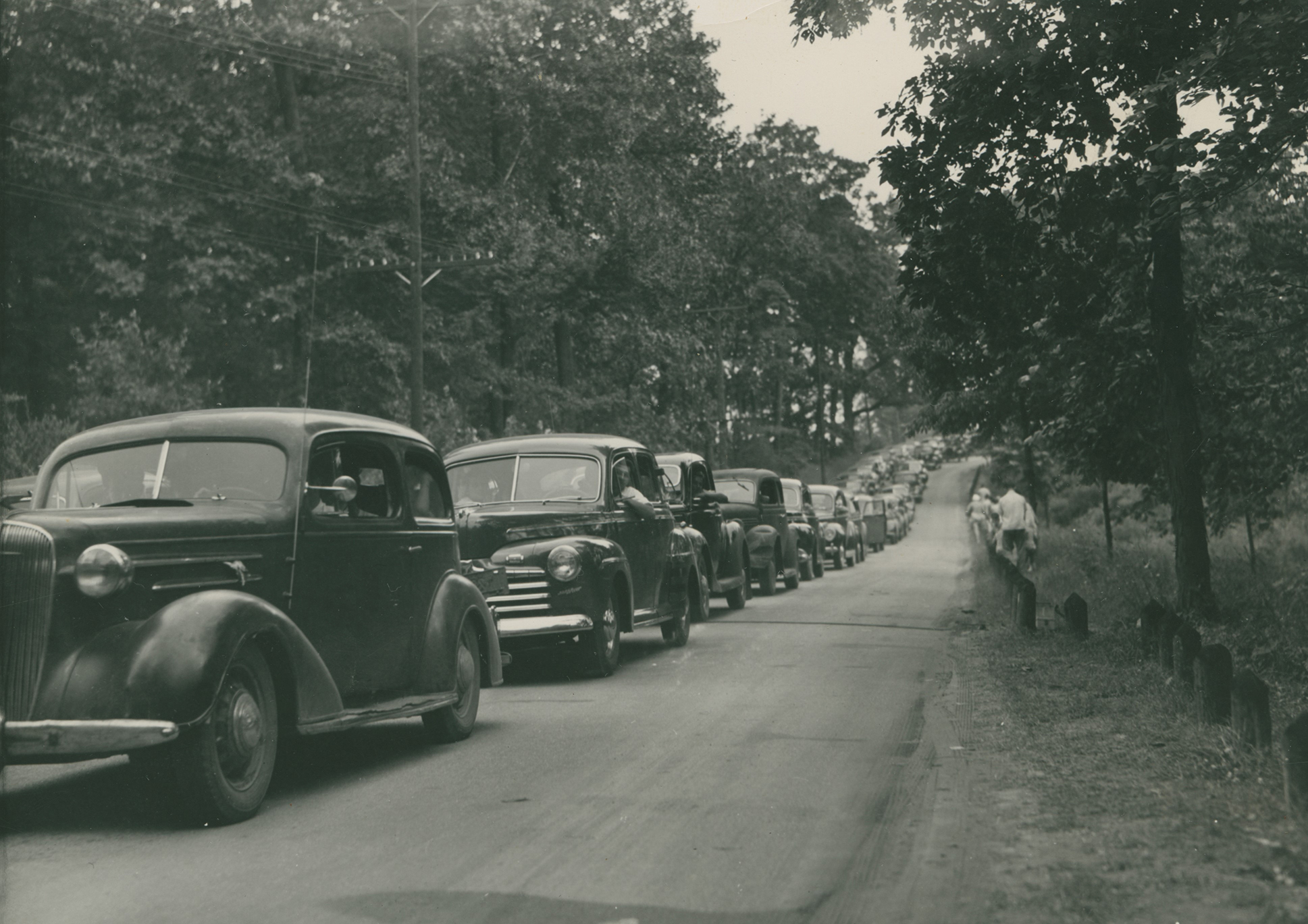
Dodge #4 1 and Dodge #4 2: Dodge #4 State Park in Oakland County – whose land was donated to state by the Dodge Brothers Corporation in 1922 – has long been a popular outdoor recreation opportunity within a short drive from urban areas. The historic photo, taken in 1940, shows a line of cars waiting to get into the park. (Dodge #4 1 courtesy of Archives of Michigan.)

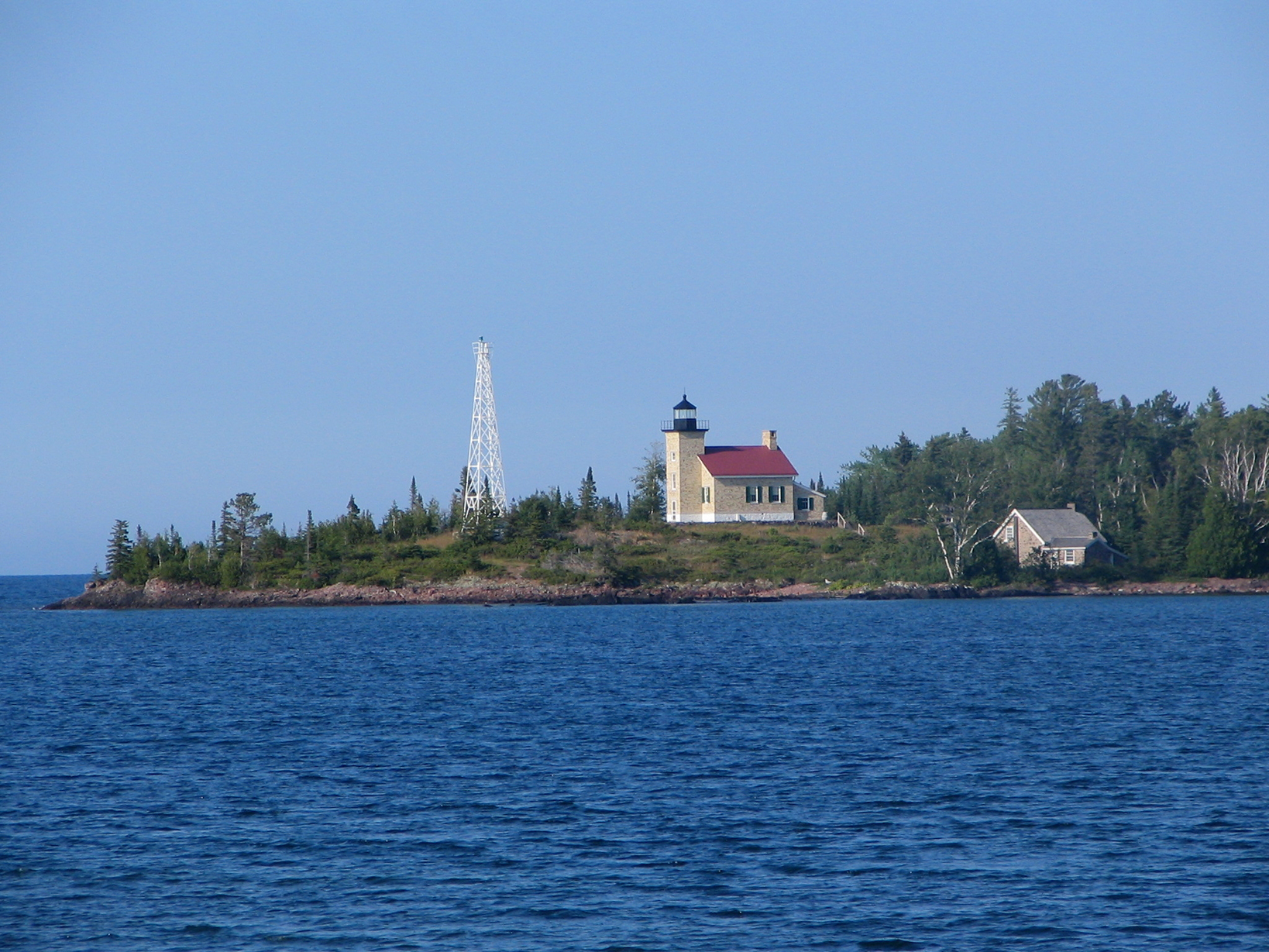
Fort Wilkins 1Fort Wilkins 2 and Copper Harbor: As cars became a more prevalent mode of travel and Michigan’s network of roads expanded, tourists could more easily visit remote outdoor attractions like Fort Wilkins State Park and Copper Harbor Lighthouse, located at the tip of the Keweenaw Peninsula. (Fort Wilkins 1 and Fort Wilkins 2 courtesy of Archives of Michigan.)

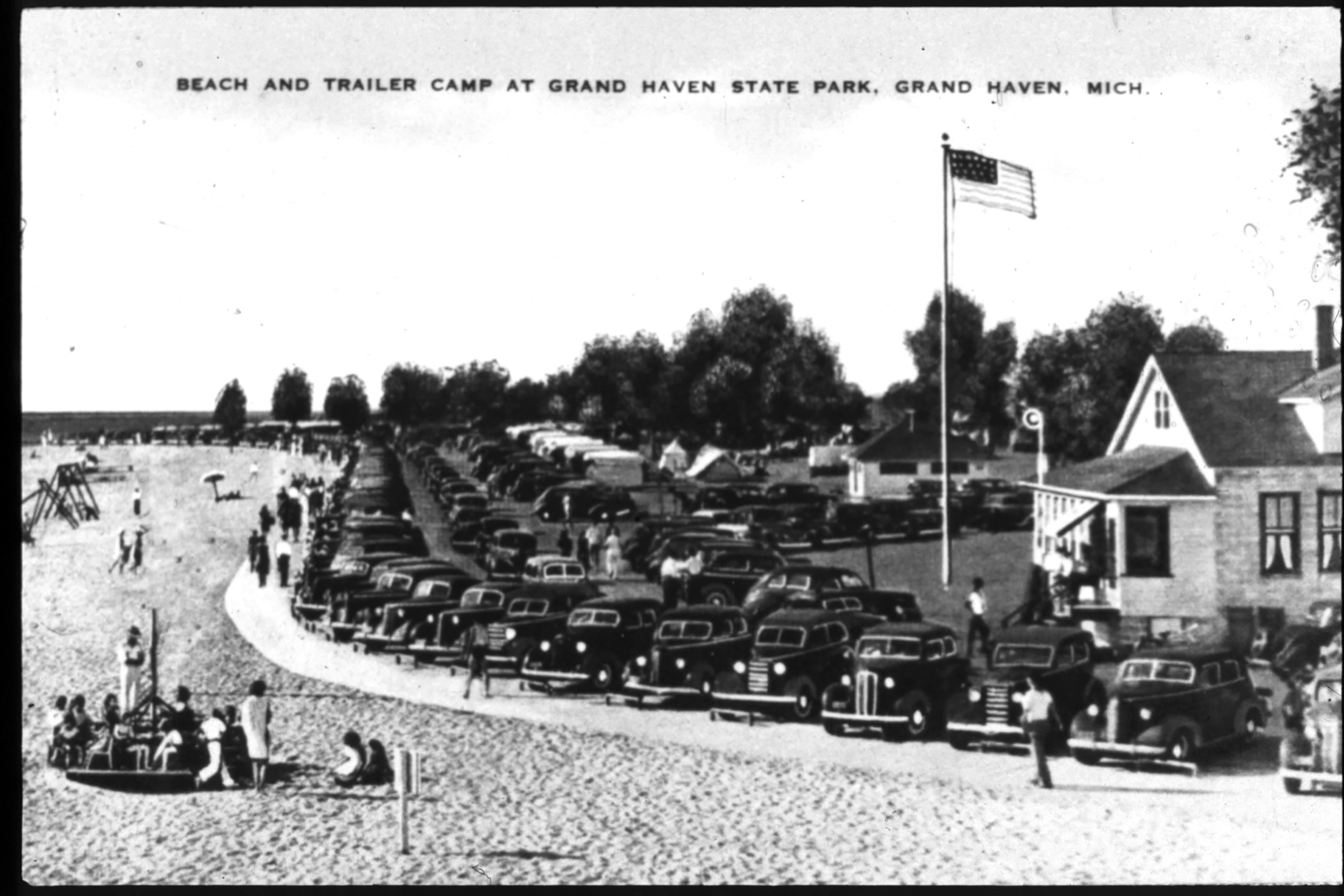
Grand Haven 1 and Grand Haven 2: Today and decades ago, Grand Haven State Park in Ottawa County is a favorite recreation destination for those traveling by car.

Island Lake: This 1938 photo shows a full parking lot at Island Lake Recreation Area in Livingston County. (Courtesy of Archives of Michigan.)

Tahquamenon Falls 1 and Tahquamenon Falls 2: The advent of auto travel enabled Michigan residents and visitors to enjoy more of Michigan’s scenic locations, like Tahquamenon Falls State Park in the eastern Upper Peninsula. Today tourists flock to these popular destinations that are just a car ride away./


Michigan Auto Dealers Self Insured Fund (MADSIF) logo

Focusing on Loss Control is the Best Way to Save WC Premium Dollars!

MADSIF – A Risk Management Tool Designed to Prevent Claims and Reduce Your Premiums

Taking the time to understand the drivers behind your workers’ compensation costs and making a long-term commitment to a comprehensive loss control program designed to control those drivers is the best method for reducing your WC premium.

Shopping carriers may bring short-term savings but unless the true issues behind your WC costs are addressed those savings will be just that, short term.

The main driver of your WC premium is your loss control program. The success or failure of the program is reflected in the severity ($ amount) and frequency (# of) of your WC claims. The frequency and severity of your claims are inputs which help determine your experience MOD factor. Like accidents and tickets serve as predictors of future losses for your auto insurance the MOD factor does the same for your WC costs. The more claims you have the higher your MOD factor becomes. Higher MOD factors increase your WC premium and lower MOD factors reduce your WC premium. Through the application of the MOD factor, in almost all cases, it is the employer who ultimately pays for their employee’s injuries, not the insurance company.

If you continue to incur losses it doesn’t matter how many different carriers you quote with your premium will eventually increase to pay back the insurance company for those claims.
To truly reduce costs employers must implement a loss control program designed to reduce hazardous conditions which reduces claims, lowers your MOD factor which ultimately will minimize your premium costs.

The MADSIF Experience

The MADSIF comprehensive loss control program is free to members. It has proven to dramatically increase the Dealer’s bottom line.

The average MOD factor for MADSIF members is .89. This means that through MADSIF’s stringent underwriting, aggressive claims handling and our Member’s commitment to loss control the average Member receives an 11% discount on their premium.

These safety training programs when instituted and monitored on a continuing basis have prevented accidents, lowered exposures to MIOSHA citations and fines, and ultimately minimized these dealers’ costs of workers’ compensation insurance. The program has also provided safe working environments for dealer employees which has increased their productivity and increased profits for the dealership.

The MADSIF Program consists of the following:

  1. An annual MADSIF safety survey designed to target hazardous conditions and MIOSHA compliance. (All hazardous conditions are identified and reported to Dealership Management – This includes photos when helpful)
  2. A Follow-up letter is left with the dealership to complete which notifies MADSIF of the date the hazardous conditions were corrected and what actions were taken.
  3. A follow-up visit if necessary
  4. Expert Assistance when MIOSHA visits your dealership
  5. Periodic Training and Seminars

MADSIF members who focus on the risk factors that prevent injuries can significantly reduce their MOD factor and minimize their WC premiums.

MADSIF acts less like an insurance company and more like a risk management partner to help you lower your long-term workers’ compensation costs.

Learn more here.  Or call MADSIF at 866-919-9578 for a free quote or if you have any questions.