
Blue Cross Blue Shield Blue Care Network of Michigan logo

Five Surprising Ways Stress Affects the Body

The stress response is a signal to the brain and body that helps us identify psychological and physiological issues. In short bursts, it can be beneficial as a safeguard against impending danger, but when left unchecked, its continuous presence has a detrimental effect. Here are five surprising ways chronic stress can negatively affect the body.

  1. Alters Digestive System: The gut is often referred to as the “second brain” for the way it impacts mental and physical well-being. Chronic stress shows short and long-term effects on gut health, from a less efficient immune system to a heightened risk of digestive disorders including: Crohn’s Disease, Irritable Bowel Syndrome (IBS), constipation, diarrhea and food allergies.
  2. Causes Weight GainChronic stress has been linked to biochemical changesin the body that trigger cravings, change digestion and increase appetite. Pairing our bodies’ natural desire for comfort foods with the convenience of drive-thru restaurants and processed meals is a recipe for disaster under stressful circumstances.
  3. Impacts Heart Health: Researchers have found that chronic stress may pose a risk for heart disease, the leading killer of men and women in America. Not only can it contribute to a rise in blood pressure and cholesterol levels, it may lead to overeating and inactivity. Interestingly enough, laughter and happiness can lower your blood pressure, reduce the risk of stroke, heart attacks and other cardiovascular problems.
  4. Induces Depression/AnxietyAn anxiety disorder can occur when the symptoms of stress continue after the stressor, or perceived threat, is gone. It can also lead to depression if feelings of anxiousness or irritability become suppressed or are unresolved for long periods of time. Viable treatment options include psychotherapy and medication.
  5. Worsens Diabetes: The American Diabetes Association shares stress can cause or worsen cases of Type 1 and Type 2 diabetes by raising blood sugar levels, activating fat cells and increasing blood pressure. It also contributes to insulin resistance, making it more difficult for the pancreas to secrete insulin.

Stress Reduction Techniques

The key to managing stress is setting realistic goals and adapting a healthier lifestyle. That includes eating nutrient-rich foods and exercising regularly, which can decrease blood pressure and improve your mood. It’s also important to reset and recharge the body with a proper amount of rest. Taking time to relax can restore emotional well-being, boost critical thinking and reduce the production of stress hormones. Simple methods include:

Stress management is an ongoing process that requires a full commitment. If it feels beyond one’s control, contact a primary care physician for additional treatment options.

If you found this post helpful, you might also enjoy:

About the author: Dr. Duane J. DiFrancoMD is vice president of Medicare Stars and Clinical Performance at Emergent Holdings, a subsidiary of Blue Cross Blue Shield of Michigan. For more health and stress management tips, visit AHealthierMichigan.org and AHealthierMichigan.org/podcast.

NADA logo

How much do Michigan dealerships support our economy?

MADA encourages Michigan dealers to take part in the NADA Workforce Study. The information collected from dealers will later be used to show the economic importance of franchised dealers in Michigan and the nation. Especially now, with a vastly different Michigan Legislature, this economic data is important to show the value of Michigan’s dealerships to our state’s economy.

The data is also a valuable resource for dealers who use it to compare their dealerships against aggregated data from peers across the nation and region, right down to dealerships selling the same brand in Michigan.

This study is a complimentary program offered to NADA members. In order for Michigan dealers to get the greatest benefit, we need a large percentage of Michigan dealers to participate. If you participate annually – thank you. If you have not done so previously, please consider doing so this year. The results to your dealership and our association are worth the effort put in. Learn more at www.nadaworkforcestudy.com.

If one voice can make a change, consider what a million voices could do

37,133 people died in motor vehicle crashes in 2017*.  This has to change.

The National Foundation for Teen Safe Driving and other driving and safety advocates are raising awareness of the facts and championing evidenced-based strategies that can save lives.

It’s important to understand that crashes are not accidental.  In fact, statistics indicate that many of the crash fatalities can be avoided. Today, advancements in technology have accelerated the development of more and more safety features in vehicles.  The evolution of advanced driver assistance technology has made great strides, and one day fully automated cars that drive us will become a reality.  Until that time, and even with new technology, human error will continue to add to the risk of fatal crashes. ​


Before we can discuss solutions, it’s important to understand the facts and underlying causes of the fatalities.

Here are some 2017 facts.  Of the 37,133 lives lost,

  • 25,096 killed were either driving or passengers in the vehicle.

  • 5,286 were motorcyclists

  • The rest were mainly pedestrians >7,000

Let’s drill down a bit more:

  • 10,497 victims had a blood alcohol level of greater than .08

  • 9,234 were driving too fast or in excess of the posted limit

  • 3,890 drivers swerved

  • 9,657 drivers killed were unrestrained* and

  • 10,428 passengers killed were unrestrained*

       * (not using a seat belt or child passenger restraint)

Or we could say

  • 20,079 lives might not have been lost had the victims been wearing a seatbelt or properly restrained in a child passenger seat

  • Over 10,000 deaths could have been prevented had there been a “designated driver” or really understanding that drinking and driving don’t mix

  • Was that child passenger restraint one of the estimated 46% that were not correctly installed or misused?

And afterwards, friends and loved ones of the victims are plagued by thoughts of “what if.”


So many of these senseless tragedies could have been avoided.  We know the facts and we know how to prevent them. But we can’t assume that everyone does.  So what do we do?

Dealers are encouraged to join the campaign and share these messages with customers and shoppers.

How can a program like this add value and influence change?  Safe driving begins with behavior.  Consider the factors that influence our behavior.  Some are internal and depend directly on us and our motivation. But more are influenced by our friends, family and the environment we put ourselves in.

Think about it.  More than 20,000 lives might have been saved had they buckled up.  It’s a simple solution, but sometimes we need a reminder.  We can talk about making a difference or we can make a difference.

So let’s do this and together we will save lives.

To learn about these evidenced-based strategies and what you can do to help make our roads safer, please visit www.soletsdothis.org

CARS e-Services – a new era begins

The Michigan Department of State is launching a new computer system that will provide you with improved services online and at all Secretary of State offices. We call it our Customer and Automotive Records System or CARS for short.

The new system begins operation Tuesday, Feb. 19, 2019, and includes services for vehicle owners and automotive-related businesses. The second phase, expected to be introduced in February 2021, will include driver’s license and ID card services.

CARS will enhance services for Michigan residents by adding new online options, improving existing online and kiosk services, and giving staff a more efficient tool to look up vehicle information and process transactions. CARS updates records in real time and replaces antiquated 1960s legacy mainframe technology that has impeded the department’s ability to optimally serve customers.


Presidents Day weekend closure

To transition to the new system:

  • Secretary of State branch offices, online services and auto business transactions will be taken offline and unavailable from Friday, Feb. 15, until 9 a.m. Tuesday, Feb. 19. The seven Super Centers usually open Saturday will be closed Saturday, Feb. 16, for the system-wide conversion. All branches will be closed on Presidents Day (Monday, Feb. 18).
  • Self-service kiosks will be taken offline in phases beginning Friday, Feb. 8. (See the schedule.)


Feb. 19 launch and thereafter

For a few weeks following the launch, as staff gets accustomed to the new computer system and adjusts to a different process for handling transactions, service in offices may take longer. Customers are encouraged to use CARS e-Services at ExpressSOS.com or to complete their transactions outside this timeframe.

Late fees will be waived for transactions with expiration dates between Feb. 11 and March 2.

We appreciate your patience and understanding as the department modernizes its vehicle record computer system.


Get transactions done fast with CARS e-Services

Customers will enjoy several new online services under CARS, including the ability to:

  • Request a personalized plate
  • Buy new vehicle plates and replacement plates
  • Renew a snowmobile registration
  • Purchase a Recreation Passport
  • Order a replacement for a lost tab

Auto dealers, repair facilities, mechanics and driver education providers and instructors also will be able to perform many business and professional licensing transactions online.

Plus, CARS will offer improvements to existing online services:

  • Experience a more user-friendly, intuitive interface
  • Renew your vehicle or watercraft registration
  • Request a duplicate registration or title
  • Change your address on your vehicle registration
  • Use one shopping cart for all of your transactions

Real-time data updates also will enable transactions the old system would reject because of delays in the exchange of data with branch offices.


Secure log in process with MILogin

Advanced security features will prompt online customers to create a user ID and password using MILogin, which also can be used to access other state government services in Michigan.

You still will be able to renew a vehicle registration without a password if you are just doing a quick renewal, as is currently the case.


CARS in Secretary of State offices

CARS also provides Secretary of State staff with new technology to make your office visit better:

  • A single record for each customer lists all their vehicles and other items. Branch employees   won’t have to search through multiple separate databases to pull information together to  complete your transaction.
  • Transactions will be tracked in real time, and notes and scanned documents can be attached easily to customer records.
  • Self-service kiosks now will offer watercraft registration renewals, in addition to the current license plate tab renewals.
  • You will be able to order an instant title at any office.


Second phase: Expected in February 2021

In February 2021, the CARS project will unveil driver-related transactions and services. The same straightforward functionality and access made available for vehicle transactions will be provided for all driver-related tasks online and at Secretary of State offices.

Tens of millions of driver and vehicle records will be securely combined into one integrated customer record system.


https://www.michigan.gov/sos/0,4670,7-127–484544–,00.html 

Celebrating 100 years of Michigan state parks

From iconic destinations like Tahquamenon Falls State Park in the eastern Upper Peninsula to lesser-known gems like Hayes State Park in southeastern Michigan’s Irish Hills, the Great Lakes State offers 103 state parks to enjoy.

Get to know more about Michigan’s state parks in the “Showcasing the DNR” series…

By CASEY WARNER, Michigan Department of Natural Resources

Visitors enjoy picnic area at Hayes State ParkWithin these parks, there’s hunting and fishing along with campgrounds, boat launches, swimming beaches, trails and lighthouses.

Whether it’s city destinations like Belle Isle Park and the Outdoor Adventure Center or wilderness areas like Craig Lake State Park, Michigan has plenty to offer.

But before 1917, our state parks numbered only one – Mackinac Island State Park, which was established in 1895 as a gift from the federal government. It had been the country’s second national park.

Interlochen State Park is considered Michigan’s first official state park, having been purchased by the state Legislature in 1917.

At the beginning of the 20th century, when Michigan’s population rapidly expanded as the automobile industry grew, cars became affordable and people could drive from their urban homes to the country or the lakeshore. But with few places available for the public to enjoy these scenic outdoor settings, it became clear that a statewide system of recreational areas open to everyone was needed.

According to P. J. Hoffmaster, Michigan’s first superintendent of state parks: “The appearance of ‘No Trespassing’ and ‘Private Property, Keep Out’ signs has been a growing one, all tending toward an approaching era of exclusion of the great mass of our residents and visitors from wonderful recreational advantages offered by the state. Through this, if nothing else, has come the setting aside of tracts of land and water by the people for the use and enjoyment of all.”

A scenic view of forest at Yankee Springs Recreation AreaOn May 12, 1919, the Michigan Legislature established the Michigan State Park Commission to oversee, acquire and maintain public lands for state parks.
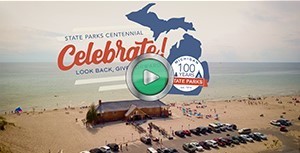


To commemorate this historic milestone, the Michigan Department of Natural Resources will celebrate the 100-year anniversary of Michigan state parks throughout 2019.

“A hundred years ago, people in Michigan were rallying to protect the state’s most beautiful outdoor destinations,” Ron Olson, chief of the DNR Parks and Recreation Division, said. “Fast forward through time and you’ll find that generations of residents and visitors have fallen in love with these treasured natural places.”

The centennial celebration will encourage the public to get involved by sharing their stories and photos, attending events taking place throughout the year, exploring a new or favorite park, learning more about the history of state parks and much more.

Still frame from state parks centennial videoLearn more about how to get involved in commemorating the 100-year legacy of Michigan state parks – and about the parks and their history – at michigan.gov/stateparks100.

An average of 28 million people each year visit Michigan state parks ranging from Milliken State Park and Harbor in Detroit – Michigan’s first urban state park providing a green oasis in the heart of the city – to Porcupine Mountains Wilderness State Park, offering one of the few remaining large wild areas in the Midwest.


Keep reading this “Showcasing the DNR” series here.

Photo Credit: Michigan Department of Natural Resources.

USPS postage rate increase effective Jan. 27, 2019

The U.S. Postal Service (USPS) will implement new postage rates for most mailing and shipping products on Sunday, January 27, 2019. Following is an overview of the new prices.
  • The First Class Mail letter (1 oz.) rate for postage is increasing by five cents to $0.55 (from $0.50).
  • Each additional ounce for a First Class Mail letter will cost an extra $0.15 (a decrease from $0.21 in 2018).
  • Priority Mail Express will see an average increase of 3.9%.
  • Priority Mail will see an average increase of 5.9%.

$1.2 million awarded to improve two automotive training labs in Michigan

Nearly 6,000 automotive tech students in Michigan will be among the first beneficiaries of the state’s Marshall Plan for Talent grants. The Marshall Plan was created by former Governor Snyder to address talent gap issues and develop innovative solutions to close the gap.

The Middle Michigan Professional Trades Consortium, a group of partners from industry, education and community organizations, was awarded more than $1.2 million dollars from the Marshall Plan to improve two automotive training labs. The labs will be used by Clare and Gladwin County Career & Technical Education, and Mid Michigan College students.

The grant will accomplish several objectives in CTE Automotive & Diesel Technology labs in Clare and Gladwin counties, assisting with the purchase of modern equipment and technology, as well as hiring Career Navigators to assist students and establishing an educator externship program. Through a partnership with Mid Michigan College, students in the automotive program will have the opportunity to earn more industry-recognized certifications while still in high school.

With the current shortage of automotive technicians, this is a significant program that will benefit dealerships, repair facilities and our customers. Please read more here.

MADA logo

Welcoming in new MADA officers

As we begin a new year with new MADA officers, we would like to thank Ms. Colleen Chapleski for serving as MADA president in 2018. She put in a lot of time and effort behind the scenes to support the interests of our members in Michigan. We appreciate her commitment to dealers throughout Michigan and look forward to working with her in her new position as MADA past president .
We welcome the new 2019 MADA officers and thank them for agreeing to serve this year.
  • President Jeff Williams
  • First Vice President Steven Brown
  • Second Vice President William Perkins
  • Immediate Past President Colleen Chapleski
Each year this group of dealers works closely with the MADA board and association staff to guide and advise on issues important to dealers. They communicate with their colleagues around the state, speak to government officials when regulatory topics require dealer involvement, help guide association policies and procedures, and stay informed on many other topics and issues. The support and involvement of these individuals is critical to the success of our association and helps us maintain a positive and prominent presence in Michigan.

Michigan minimum wage increases to $9.45 in late March 2019

Governor Rick Snyder signed bills into law on Friday, December 14 that revise the minimum wage.
Under the revised law, Michigan’s minimum wage will increase from $9.25 to $12.05 per hour by 2030. The new minimum wage rules eliminate an existing mechanism designed to allow the state’s rate to rise with inflation in future years.
An increase in the minimum hourly wage rate does not take effect if the unemployment rate for Michigan, as determined by the Bureau of Labor Statistics, is 8.5% or greater for the calendar year preceding the prescribed increase. If an increase does not take place in a given year, that rate will go into effect the following year, assuming the unemployment rate is less than 8.5%.
The $9.45 minimum wage will go into effect on the 91st day after final adjournment of the 2018 legislative session. Once the current legislative session is officially closed the exact implementation date will be announced. We anticipate it will be late March 2019.